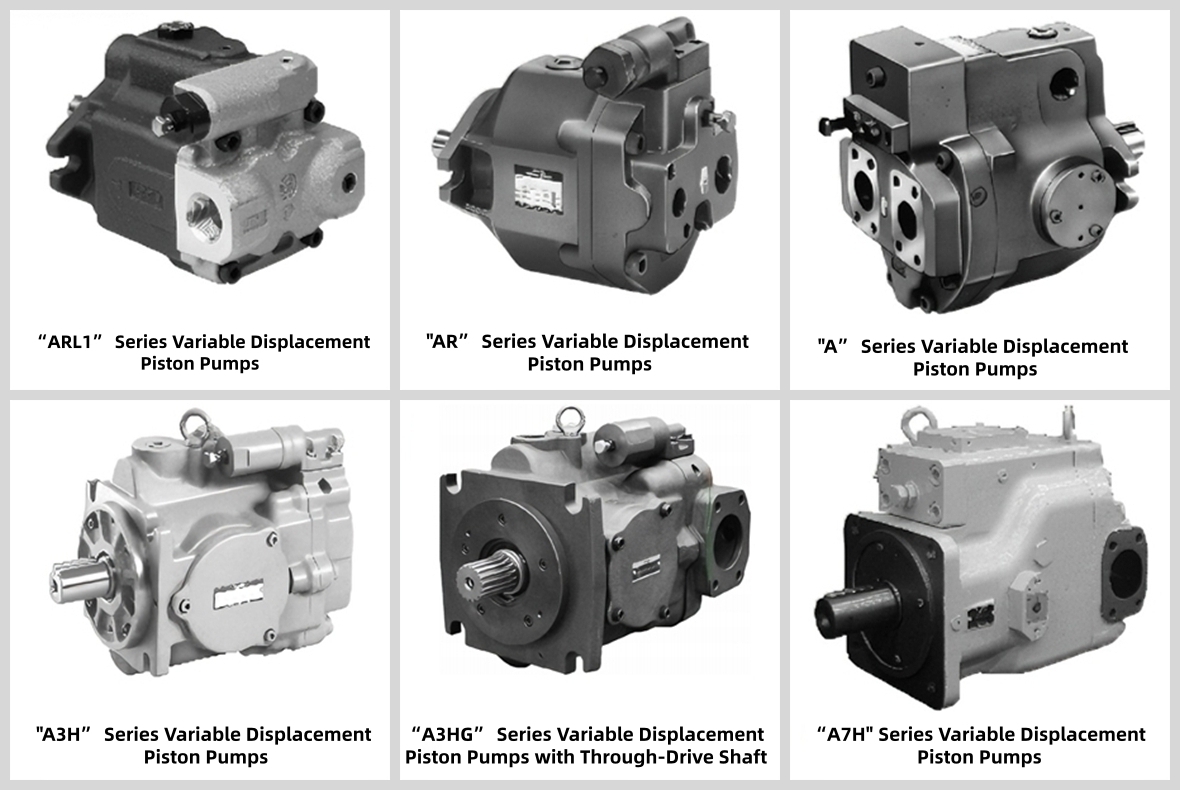
YUKEN ASE、ASR Piston Pump

Parameters of YUKEN Piston Pumps Models ASE and ASR Series
1. Model Interpretation
YUKEN ASE and ASR are variable displacement axial piston pumps designed for medium to large-sized hydraulic systems requiring high pressure, high efficiency, and reliable performance. These pumps feature a robust swash plate design, low noise operation, and advanced control options, making them widely used in industrial machinery, construction equipment, and mobile hydraulic applications. The ASE and ASR designations indicate specific control features and structural configurations optimized for different operating requirements.
1.1 Model Coding Rules (Unified for Both Series)
-
A: Series code, indicating YUKEN A series variable displacement axial piston pump with swash plate design for high pressure and high efficiency operation.
-
S: Sub-series code, indicating “Standard” configuration with optimized performance for general industrial applications.
-
E/R: Control type code, indicating the specific control mechanism:
-
E: Electro-hydraulic proportional control (proportional solenoid for remote flow and pressure adjustment with electronic feedback).
-
R: Pressure compensator control (automatic flow adjustment based on system pressure to maintain constant pressure).
-
-
Additional Codes: Complete model typically includes:
-
Nominal displacement: 16, 22, 37, 56, 70, 90, 100, 145 (cm³/rev)
-
Mounting type: F (flange mounting), L (foot mounting)
-
Rotation direction: R (clockwise viewed from shaft end), L (counterclockwise)
-
Design number: 01/02/03 indicating specific design variations
-
Note: The ASE and ASR series share the same basic structure (variable displacement axial piston pump with swash plate design), with differences primarily in control mechanism, displacement range, and specific performance optimizations to meet diverse application requirements.
2. Technical Parameters
|
Parameter Item
|
ASE Series (Typical: ASE37)
|
ASR Series (Typical: ASR70)
|
Unit
|
|---|---|---|---|
|
Nominal Displacement
|
16, 22, 37, 56, 70, 90, 100, 145
|
16, 22, 37, 56, 70, 90, 100, 145
|
cm³/rev
|
|
Pump Type
|
Variable Displacement Axial Piston Pump (Swash Plate Design)
|
–
|
|
|
Control Type
|
Electro-hydraulic Proportional Control (E-type)
|
Pressure Compensator Control (R-type)
|
–
|
|
Maximum Operating Pressure
|
31.5 (Continuous), 35 (Peak)
|
31.5 (Continuous), 35 (Peak)
|
MPa
|
|
Rotation Direction
|
Clockwise (R) / Counterclockwise (L) Viewed from Shaft End
|
Clockwise (R) / Counterclockwise (L) Viewed from Shaft End
|
–
|
|
Rated Speed
|
1800
|
1800
|
rpm
|
|
Maximum Speed
|
2400
|
2400
|
rpm
|
|
Minimum Speed
|
600
|
600
|
rpm
|
|
Maximum Flow Rate (at Rated Speed)
|
Up to 261.0 (ASE145)
|
Up to 261.0 (ASR145)
|
L/min
|
|
Displacement Adjustment Range
|
0-100% of nominal displacement
|
0-100% of nominal displacement
|
–
|
|
Control Pressure Range
|
0.3-3.5 MPa (Proportional Solenoid)
|
0.8-2.5 MPa (Pressure Compensator)
|
MPa
|
|
Operating Temperature Range
|
-10 ~ 80
|
-10 ~ 80
|
°C
|
|
Applicable Fluids
|
Petroleum-based hydraulic oil, anti-wear hydraulic oil (ISO VG 32-68)
|
–
|
|
|
Oil Cleanliness Requirement
|
NAS 7 or higher (≥10 μm filtration)
|
–
|
|
|
Solenoid Voltage (E-type)
|
DC24V (Standard), DC12V/AC220V (Optional)
|
–
|
–
|
|
Solenoid Power Consumption (E-type)
|
25W (DC24V)
|
–
|
W
|
|
Weight (Typical)
|
ASE37: 32 kg, ASE70: 58 kg
|
ASR37: 30 kg, ASR70: 56 kg
|
kg
|
2. Product Features
2.1 Common Features (Applicable to Both Series)
-
Swash Plate Design: Compact structure, high power density, and excellent mechanical efficiency (up to 95%) for high pressure and high flow applications.
-
Variable Displacement: Allows precise adjustment of flow rate from 0 to maximum displacement, improving energy efficiency and reducing system heat generation.
-
High Pressure Capability: Continuous operating pressure up to 31.5 MPa, peak pressure up to 35 MPa, suitable for heavy-duty hydraulic systems.
-
Low Noise Operation: Special design reduces operating noise by up to 5dB compared to conventional piston pumps, ideal for noise-sensitive environments.
-
High Reliability: Adopts high-quality materials and precision manufacturing processes, ensuring long service life (≥10,000 hours) and stable operation under harsh conditions.
-
Easy Maintenance: Modular design, easy to disassemble and maintain, with replaceable wear parts for cost-effective maintenance.
-
Multiple Mounting Options: Available in flange (F) and foot (L) mounting configurations for flexible installation in various hydraulic systems.
2.2 Series-Specific Features
-
ASE Series (Electro-hydraulic Proportional Control):
-
Enables remote flow and pressure adjustment via electrical signals, improving system automation and controllability.
-
Equipped with electronic feedback for precise control and monitoring of pump output.
-
Ideal for industrial machinery requiring precise flow control, such as injection molding machines, metalworking equipment, and plastic processing machinery.
-
Compatible with various control systems (PLC, PC-based controllers) for seamless integration into automated production lines.
-
-
ASR Series (Pressure Compensator Control):
-
Automatic flow adjustment based on system pressure to maintain constant pressure, reducing energy consumption during low load conditions.
-
Simplified design with fewer electronic components, resulting in lower cost and higher reliability for basic hydraulic systems.
-
Ideal for applications requiring constant pressure control, such as hydraulic presses, clamping systems, and material handling equipment.
-
Easy to operate and maintain, with manual adjustment options for pressure setting and system optimization.
-
3. Application Fields
The ASE and ASR series are widely used in various industrial and mobile hydraulic systems requiring high pressure, high efficiency, and reliable performance, with specific application scenarios differentiated by control features and performance requirements:
-
ASE Series: Injection molding machines, metalworking equipment (CNC lathes, milling machines), plastic processing machinery, automated production lines, and precision hydraulic systems requiring electronic control and monitoring.
-
ASR Series: Hydraulic presses, clamping systems, material handling equipment, construction machinery, and basic hydraulic systems requiring constant pressure control and simplified operation.
4. Typical Model Variations
|
Model
|
Nominal Displacement
|
Control Type
|
Mounting Type
|
Max. Flow (at 1800 rpm)
|
Typical Application
|
|---|---|---|---|---|---|
|
ASE37-F-R-01
|
37 cm³/rev
|
Electro-hydraulic Proportional (E-type)
|
Flange (F)
|
66.6 L/min
|
Medium-sized injection molding machines
|
|
ASE70-L-L-02
|
70 cm³/rev
|
Electro-hydraulic Proportional (E-type)
|
Foot (L)
|
126.0 L/min
|
Heavy-duty metalworking equipment
|
|
ASR37-F-R-01
|
37 cm³/rev
|
Pressure Compensator (R-type)
|
Flange (F)
|
66.6 L/min
|
Hydraulic clamping systems
|
|
ASR70-L-R-02
|
70 cm³/rev
|
Pressure Compensator (R-type)
|
Foot (L)
|
126.0 L/min
|
Medium-sized hydraulic presses
|
5. Installation and Operation Notes
-
Before installation, check the pump model, nominal displacement, control type, and rotation direction to ensure they match the system requirements.
-
Mount the pump on a rigid base using suitable mounting bolts and torque specifications (refer to YUKEN technical documentation) to prevent vibration and ensure stable operation.
-
Align the pump shaft with the prime mover (motor/engine) shaft accurately (concentricity ≤ 0.1 mm) to avoid shaft bending and bearing damage.
-
Use a flexible coupling to connect the pump and prime mover, absorbing vibration and reducing mechanical stress on the shaft and bearings.
-
Connect the hydraulic lines correctly: pressure port (P) to the system pressure line, tank port (T) to the oil tank line, and control ports (X/Y) to the control system lines; reverse connection will cause pump failure and system damage.
-
Fill the pump with hydraulic oil before starting to ensure proper lubrication of internal components and prevent dry running.
-
Prime the pump by rotating the shaft manually (5-10 revolutions) to remove air from the pump and hydraulic lines before starting.
-
Start the pump at low speed (≤1000 rpm) and no load, gradually increasing the speed and load to the rated values to avoid sudden pressure changes causing equipment damage.
-
Maintain hydraulic oil cleanliness at NAS 7 level or higher, and install a high-precision filter (≥10 μm) in the system to prevent impurities from damaging the pump’s internal components (swash plate, piston, cylinder block).
-
The operating temperature of the hydraulic oil should be controlled within -10°C to 80°C; excessive temperature will affect the service life of the seal and pump performance.
-
Regularly inspect the pump for oil leakage, abnormal noise, and pressure fluctuations; if any abnormality is found, stop the system immediately for inspection and maintenance.
-
When adjusting the flow or pressure, follow the YUKEN technical manual and ensure the system is in a safe state to avoid injury or equipment damage.
-
When replacing parts, use only genuine YUKEN replacement parts to ensure compatibility and maintain pump performance; non-genuine parts may cause reduced efficiency, increased noise, and premature failure.
-
Do not disassemble the pump without authorization; if maintenance is required, refer to the YUKEN technical manual or contact professional maintenance personnel.
-
Store the pump in a dry, clean, and well-ventilated environment when not in use, protecting it from dust, moisture, and corrosion.