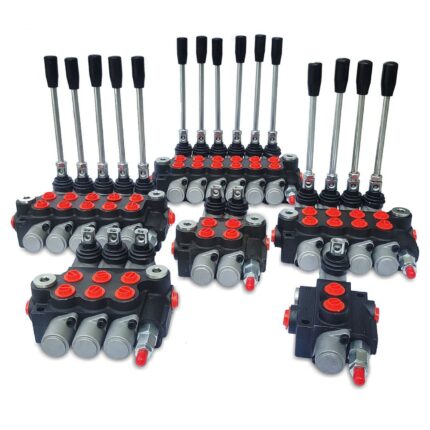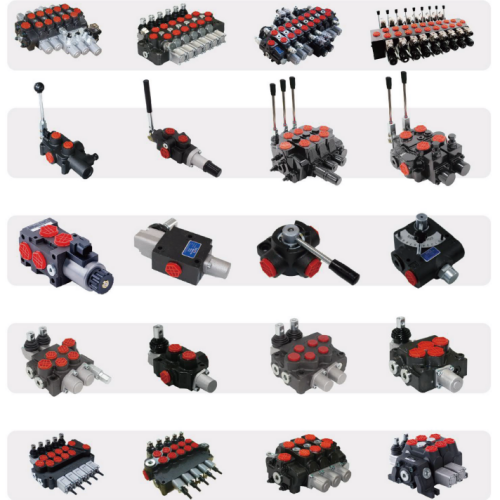


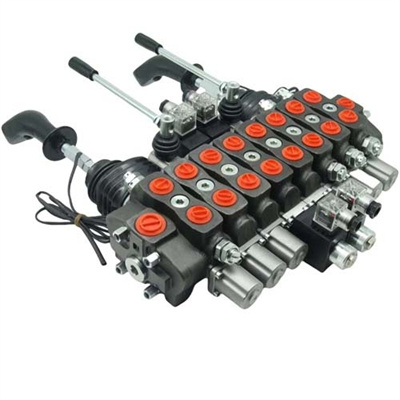
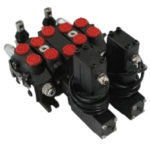
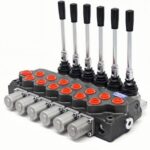

HSDSL Series directional control valve
HSD Series directional control valve: HSDCV60EM 、HSDW 、HSDSL 、HSDCV55
E-mail: hyd-sales2009@outlook.com

Speculation on technical characteristics
Structure
Integral type: If it is designed with a high degree of integration, a single valve body may be used to integrate multiple reversing valve spool, which is suitable for occasions where space is limited (such as small construction machinery).
Sharding type: If it is a modular design, it may be assembled from the oil inlet joint, the working joint, and the tail joint to facilitate maintenance and expansion (such as a large hydraulic system).
Control method
Manual control: directly operate the valve core through levers or knobs, which is suitable for low-frequency reversing scenarios (such as agricultural machinery).
Hydraulic control: The pilot oil pressure is used to push the valve core, which is suitable for high-pressure and large-flow systems (such as excavator main valves).
Electro-hydraulic proportional/switch control: driven by an electromagnet or proportional electromagnet, automatic control (such as industrial robots) is realized.
Oil circuit connection method
Parallel type: Each joint valve independently controls the actuator, which is suitable for single action or simple composite action (such as crane legs).
Series type: The oil return of the previous valve is used as the oil inlet of the latter valve, which is suitable for scenarios where pressure is superimposed (such as multi-stage hydraulic cylinders).
Composite type: combining the characteristics of parallel and series, to achieve complex action sequences (such as excavator boom + bucket rod synergy).
Performance parameters
Nominal pressure: may cover 16MPa~35MPa, suitable for medium and high pressure hydraulic systems.
Flow range: It may support 40L/min~250L/min to match the requirements of different actuators.
Leakage: The amount of internal leakage must be ≤ the standard value (such as GB/T 17491) to ensure system efficiency.
Typical application scenarios
Construction machinery
Excavator: To control the composite action of the boom, bucket rod, and bucket, high response speed and anti-pollution ability are required.
Loader: To achieve synchronous control of steering and lifting, low pressure loss and energy-saving design are required.
Industrial automation
Injection molding machine: to control the opening and closing of the mold, ejection and other actions, high-precision position control is required.
Die-casting machine: adjust the clamping force and injection speed, and it needs to be designed to withstand high pressure and impact.
Agricultural machinery
Combine harvester: control the lifting of the cutting table and the speed of the threshing drum, and it needs to be designed to be dustproof and waterproof.
Tractor: To realize the lifting and force adjustment of suspended agricultural tools, it requires low cost and easy maintenance.