Sale
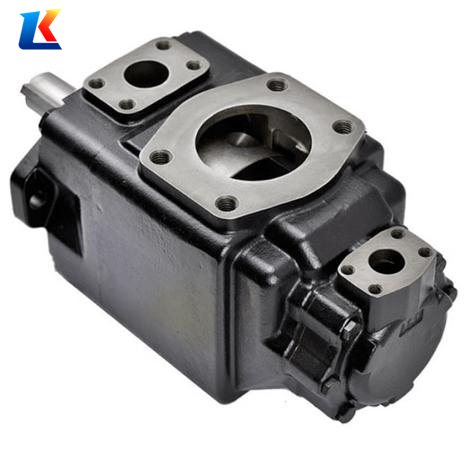
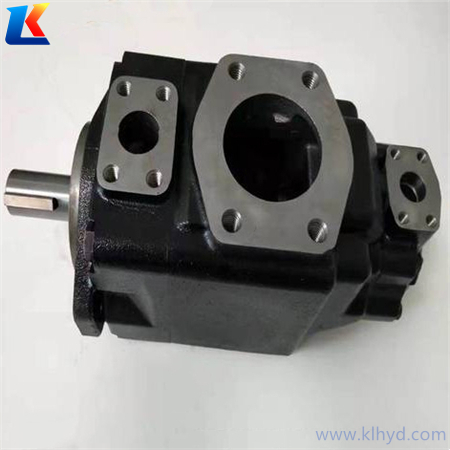
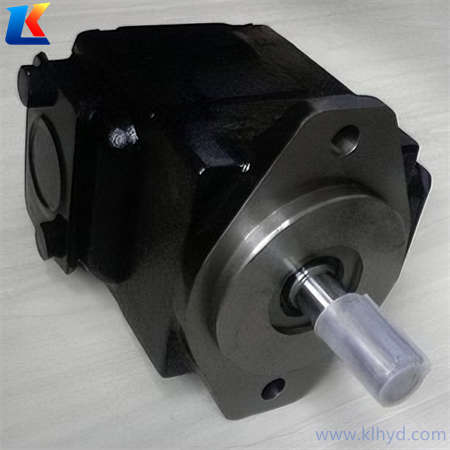
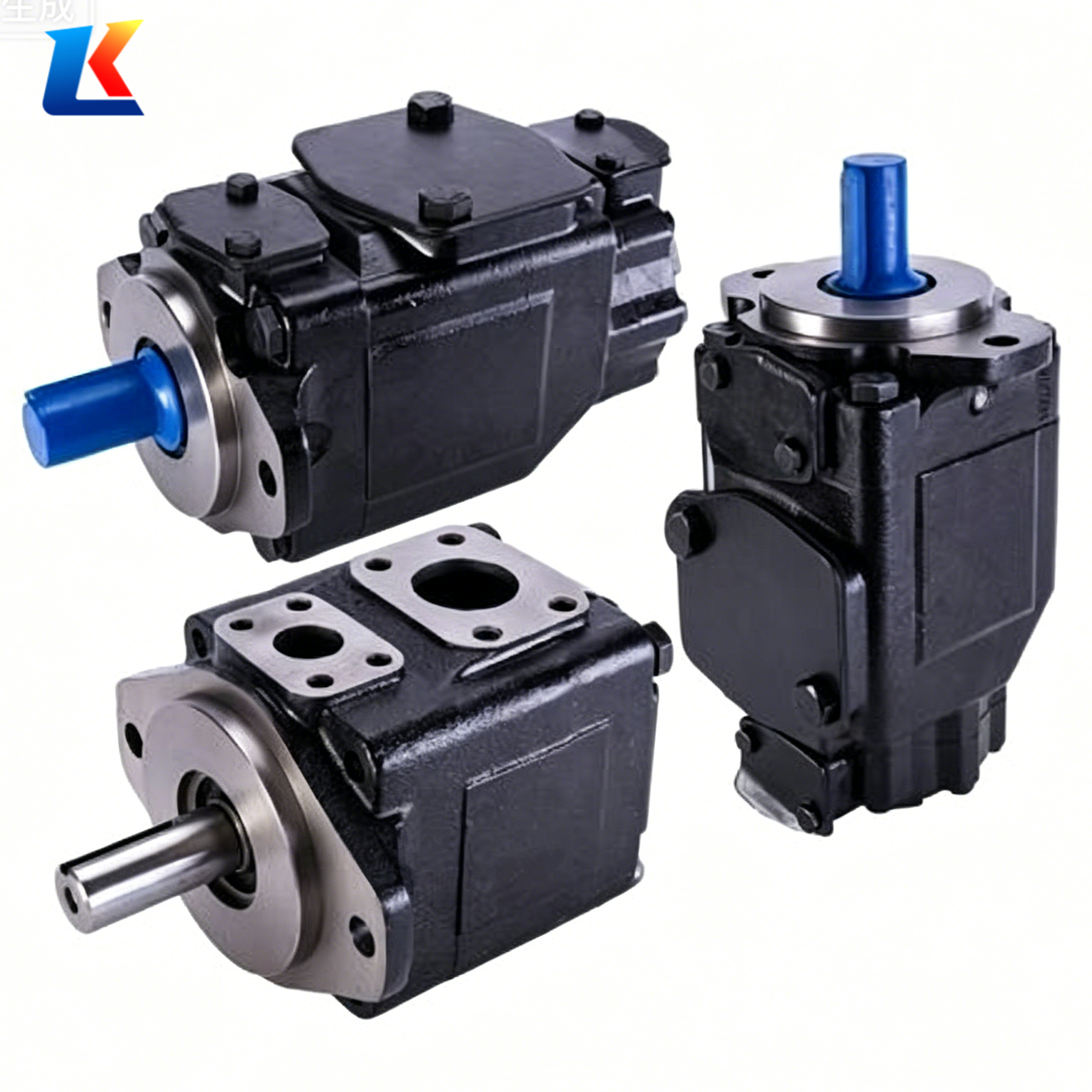
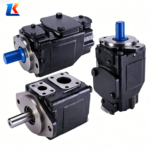


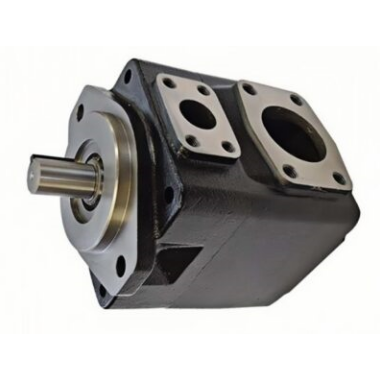
T7BB/T7BBS Parker Denison Double Vane Pump
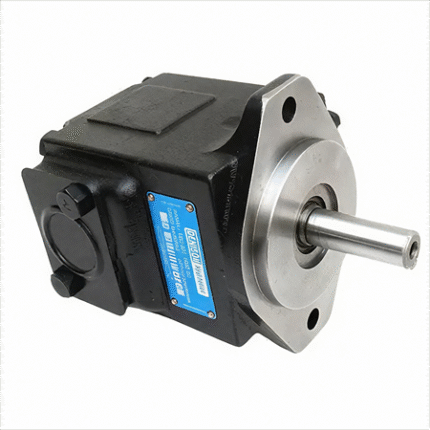
Single pump:T6C、T6D、T6E、T6CM、T6CP、T7B、T7BS、T7D、T7DS、T7E、T7ES
Double pump:T6CC、T6DC、T6EC、T6ED、T6EE、T7BB、T7BBS、T7DB、T7DBS、T7EB、T7EBS、T67CB、T67DB、T67EB、T67DBS
Triple pump:T6DCC、T6EDC、T6ECC、T6EDCC、T7DBB、T7DBSB、T7EBB、T7EBSB、T67EDB、T67EDBS、T67DCB、T67DDBS
| Contact us |
| Whats app: +86 13728707767 |
| E-mail: hyd-sales2009@outlook.com |
Description
1. Product Overview
The T7BB and T7BBS series are high-pressure fixed double vane pumps of Parker Denison T7 series. Adopting the classic double-lip vane balanced structure, the double cartridge shares a common drive shaft and provides two independent pressure and flow outputs, suitable for high-low pressure composite hydraulic circuits. Featuring high pressure impact resistance, low noise, high volumetric efficiency and strong pollution resistance, this series is widely applied in industrial machine tools, injection molding and die-casting equipment, construction machinery, agricultural machinery and marine hydraulic systems.
The core difference between the two models lies in the mounting flange standard: T7BB adopts ISO 2-bolt mounting flange for general industrial installation scenarios; T7BBS adopts SAE B J744 standard 2-bolt flange for mobile machinery and imported equipment supporting scenarios.
2. General Technical Specifications
|
Parameter Item
|
Technical Index
|
Remarks
|
|
Pump Type
|
Fixed Double Balanced Vane Pump
|
Dual independent cartridges, synchronous operation and independent oil supply
|
|
Max. Intermittent Working Pressure
|
320bar
|
Short-term impact pressure, available for small displacement single pump operation
|
|
Max. Continuous Working Pressure
|
290bar
|
Rated pressure for long-term stable operation
|
|
Rated Speed Range (Industrial Type)
|
600~3600rpm
|
Optimal operating speed: 1000~2500rpm
|
|
Rated Speed Range (Vehicle Type)
|
400~2800rpm
|
Suitable for low-speed operation of agricultural machinery and construction machinery
|
|
Minimum Stable Speed
|
400rpm
|
No jitter and no cavitation
|
|
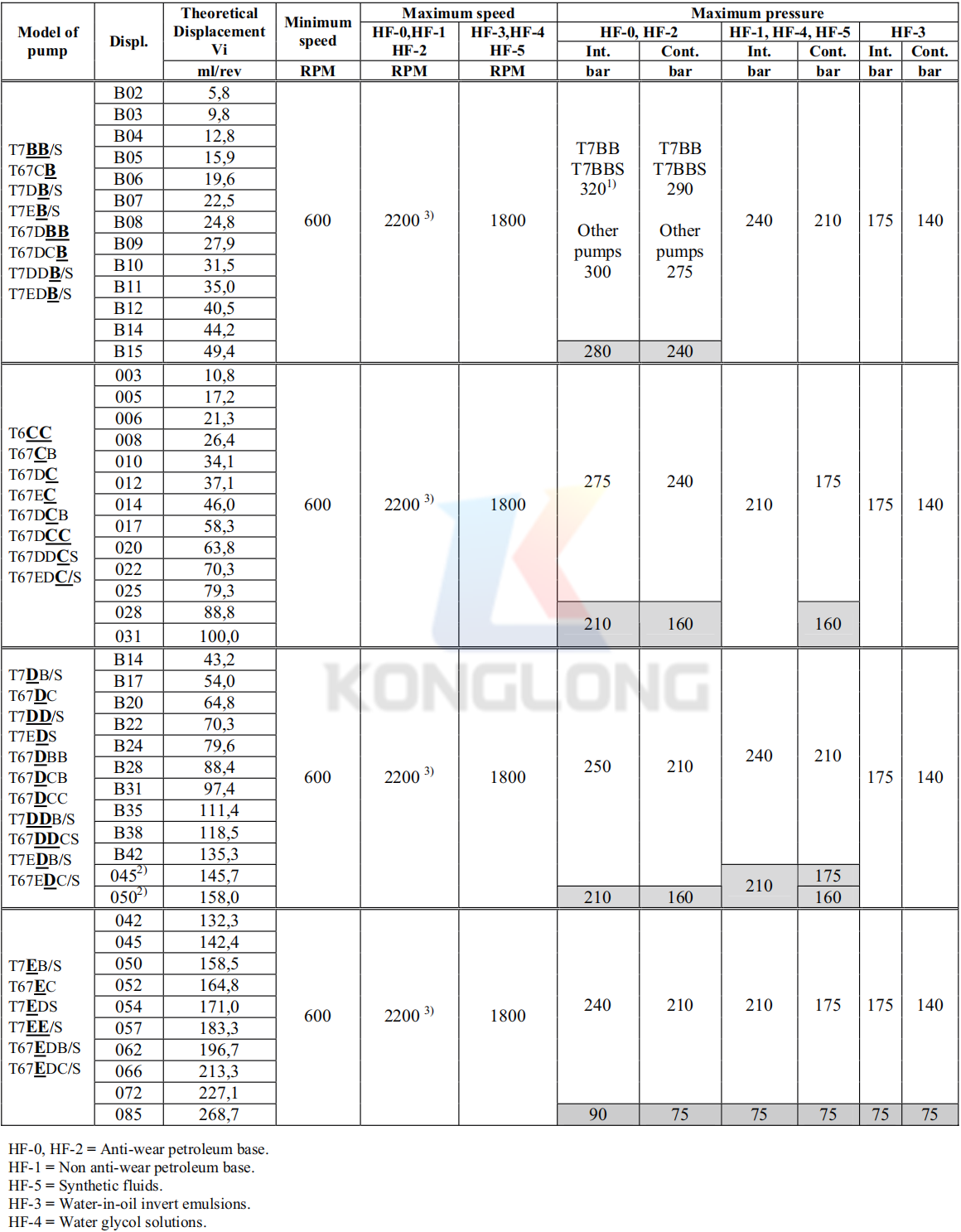
Single Pump Displacement Range
|
5.8~49.4ml/rev
|
Front and rear cartridges can be combined arbitrarily
|
|
Max. Total Double Pump Displacement
|
98.8ml/rev
|
Combination of dual B15 cartridges
|
|
Volumetric Efficiency
|
≥94%
|
Typical measured value under standard working conditions
|
|
Operating Temperature Range
|
-20℃~+80℃
|
Compatible with mineral oil, biodegradable oil and water-based hydraulic fluid
|
|
Noise Performance
|
Low Noise Design
|
3~5dB lower than ordinary vane pumps
|
|
Pump Weight
|
23kg and above
|
Varies with different displacement combinations
|
3. Displacement Specification Chart (Cartridge Parameters)
Both front and rear cartridges of T7BB/T7BBS series adopt standard B-series displacement codes. All displacements can be freely combined to meet the matching requirements of large/small flow and high/low pressure.
|
Displacement Code
|
Actual Displacement (ml/rev)
|
Displacement Code
|
Actual Displacement (ml/rev)
|
|
B02
|
5.8
|
B09
|
27.9
|
|
B03
|
9.8
|
B10
|
31.5
|
|
B04
|
12.8
|
B11
|
35.0
|
|
B05
|
15.9
|
B12
|
40.5
|
|
B06
|
19.6
|
B14
|
44.2
|
|
B07
|
22.5
|
B15
|
49.4
|
|
B08
|
24.8
|
–
|
–
|
4. Complete Model Coding Rules
General Model Format: T7BB/T7BBS-Front Pump Displacement-Rear Pump Displacement-Shaft Type-Rotation Direction-Basic Configuration-Port Direction-Seal Type. Take the standard model T7BBS-B10-B05-1R00-A1M0 as an example for segmented interpretation:
|
Code Position
|
Code Content
|
Detailed Definition
|
|
1
|
T7BB/T7BBS
|
Series Code: T7BB = ISO Flange Mounting; T7BBS = SAE B Flange Mounting
|
|
2
|
B02~B15
|
Shaft end (front) cartridge displacement code
|
|
3
|
B02~B15
|
Cover end (rear) cartridge displacement code
|
|
4
|
1/2/3
|
Shaft Type: 1=SAE B Keyway Shaft; 2=SAE BB Keyway Shaft; 3=SAE B Spline Shaft
|
|
5
|
R/L
|
Rotation Direction: R=Clockwise; L=Counterclockwise
|
|
6
|
00
|
Basic configuration, 00 stands for standard general configuration
|
|
7
|
A1
|
Standard oil port direction, customizable multi-angle installation
|
|
8
|
M0
|
Seal Material: M0=NBR standard seal, suitable for conventional working conditions
|
5. Summary of Standard Common Models
5.1 T7BB Series (ISO Flange) Common Models
Suitable for fixed industrial equipment such as machine tools, injection molding machines and hydraulic presses. Classic common displacement combinations are as follows:
-
T7BB-B05-B05-1R00-A1M0: Dual 15.9ml/rev small flow combination, for precision small hydraulic systems
-
T7BB-B08-B10-1R00-A1M0: 24.8+31.5ml/rev, universal for small and medium-sized machine tools
-
T7BB-B10-B10-1R00-A1M0: Dual 31.5ml/rev, stable medium flow output
-
T7BB-B10-B15-1R00-A1M0: 31.5+49.4ml/rev, preferred for high-low pressure composite working conditions
-
T7BB-B15-B15-1R00-A1M0: Dual 49.4ml/rev, for large-flow industrial hydraulic systems
5.2 T7BBS Series (SAE B Flange) Common Models
Suitable for agricultural machinery, construction machinery and imported supporting mobile equipment. Mainstream market models:
-
T7BBS-B03-B06-1R00-A1M0: 9.8+19.6ml/rev, for agricultural machinery auxiliary hydraulic systems
-
T7BBS-B05-B12-1R00-A1M0: 15.9+40.5ml/rev, for multi-circuit oil supply of construction machinery
-
T7BBS-B10-B14-1R00-A1M0: 31.5+44.2ml/rev, for medium and high-pressure mobile machinery systems
-
T7BBS-B15-B10-1R00-A1M0: 49.4+31.5ml/rev, dedicated for high-low pressure flow splitting
-
T7BBS-B12-B12-1R00-A1M0: Dual 40.5ml/rev, for large-flow agricultural machinery hydraulic systems
6. Core Product Advantages
-
High Pressure Durability: Stable long-term operation at 290bar continuous pressure and 320bar short-term impact pressure, applicable for heavy-duty hydraulic conditions; can replace part of piston pumps to reduce equipment costs.
-
High Efficiency & Low Energy Consumption: Adopts full pressure balance structure with volumetric efficiency up to 94%, reducing energy loss and equipment operating power consumption.
-
Strong Pollution Resistance & High Reliability: Exclusive double-lip vane structure reduces dependence on hydraulic oil cleanliness, avoiding jamming and wear failures, suitable for harsh working conditions.
-
Flexible Installation: Supports 32 installation angles, dual flange standards adapt to various equipment, with flexible layout and strong installation compatibility.
-
Convenient Maintenance: Plug-in independent cartridge design allows separate replacement of worn cartridges without overall pump disassembly, greatly shortening equipment downtime.
-
Low Noise Operation: Optimized vane meshing structure ensures low-noise operation under all working conditions, suitable for precision processing and indoor industrial equipment scenarios.
7. Core Selection Guidelines
-
Confirm the mounting flange first: Select T7BB (ISO flange) for fixed industrial equipment, and T7BBS (SAE B flange) for mobile machinery and imported equipment.
-
Match front and rear cartridge displacement combinations according to system flow requirements, and prioritize standard displacement models.
-
Strictly distinguish shaft types (keyway/spline) and rotation directions to avoid transmission system matching failure after installation.
-
Control long-term working pressure within 290bar and short-term impact pressure within 320bar to ensure pump service life.
-
Select different seal materials according to operating temperature and medium types to adapt to special hydraulic fluid working conditions.
About brand

Shipping & Delivery