JIHOSTROJ High Pressure External Gear Pump
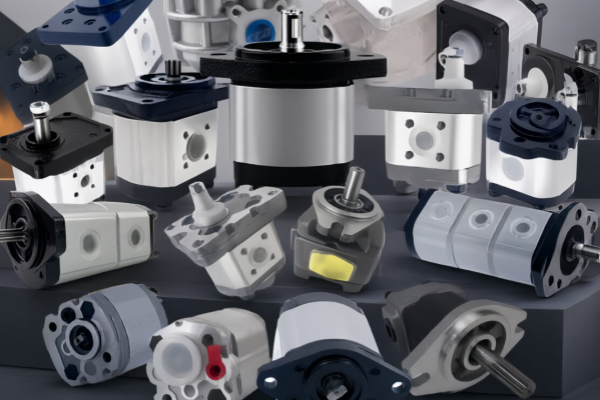
> JIHOSTROJ a.s. (Velešín, Czech Republic), rooted in aerospace hydraulics, specializes in high-pressure fixed-displacement external gear pumps with axial floating side plate pressure compensation. Different from conventional non-compensated gear pumps, it maintains high volumetric efficiency under high pressure. Versions include single, tandem, triple pumps, unidirectional and bi-rotational types.
Working Principle
It is a positive-displacement fixed pump. A pair of alloy steel gears rotate and mesh. The suction chamber expands to draw oil in, while the pressure chamber shrinks to deliver pressurized oil.
The floating compensating side plate (pressure plate) is the core component. High-pressure oil is guided to the back of the side plate, pressing it against the gear end faces automatically to compensate axial wear clearance. This is the key structure enabling operation up to 300 bar.
Series Overview (High Pressure Range)
| Series | Displacement cm³/r | Continuous Pressure | Peak Pressure | Housing Material |
|---|---|---|---|---|
| X | 0.18~3.2 | 230 bar | 260 bar | Aluminum alloy |
| P23 | 0.8~11.8 | 280~300 bar | 300~320 bar | Aluminum alloy |
| J | 2~18 | 280 bar | 300 bar | Aluminum housing + cast iron end cover |
| T3 | 4~31 | 240~290 bar | 300~310 bar | Aluminum housing + cast iron end cover |
| Q2 | 10~100 | 250 bar | 290 bar | Aluminum housing |
| QHD / GHD | 7~150 | 250~300 bar | 320~340 bar | Grey cast iron |
Key Features
1. Axial hydraulic compensation structure: Low internal leakage at high pressure, slow flow decay, longer service life than conventional bushing-type gear pumps. The side plate is the primary wearing part.
2. Special low-pulsation gear profile (12/13-tooth design): Low meshing impact, low noise and reduced pressure pulsation compared with ordinary gear pumps of the same pressure class.
3. Modular design: Optional SAE flanges, straight key / taper / spline shafts, BSP / metric threaded ports, NBR / FKM seals; multi-section combined pumps available.
4. Bi-rotational version optional. Bi-rotational pumps are equipped with separate drain port. Drain line must return directly to tank with NO backpressure (frequent failure point).
5. Good self-priming capability. Stable pressure build-up at low speed, suitable for diesel-driven mobile machinery.
6. Materials: Carburized and quenched alloy steel gears; wear-resistant composite side plates; lightweight aluminum housing or high-strength cast iron housing for heavy duty.
7. Limitation: Fixed displacement pump, flow varies with rotational speed. Not suitable for long-time relief overflow operation. Oil contamination and cavitation caused by air ingestion are the main failure causes.
Fluid, Temperature & Filtration Specifications
– Standard fluid: ISO VG32 / VG46 / VG68 anti-wear mineral hydraulic oil. FKM (Viton) seals are mandatory for phosphate ester and synthetic ester fluids.
– Viscosity: Recommended 10~100 mm²/s; Max. 1200 mm²/s at cold start.
– Oil temperature: NBR (N): -20~80℃; FKM (Viton): -20~120℃
– Fluid cleanliness: NAS 8 (ISO4406 18/15), NAS 7 for precision circuits. 10 μm return filter, 5 μm filter for precision systems.
– Suction vacuum: ≥ -0.3 bar to avoid cavitation.
Typical Applications
– Industrial hydraulics: High-pressure hydraulic power units, machine tool clamping / lubrication, injection molding, die casting, automated production lines
– Agricultural machinery: Tractors, combine harvesters, silage harvesters, balers (J, Q2 series)
– Construction & mobile machinery: Mini excavators, aerial work platforms, forklifts, sanitation trucks, road construction, mining heavy-duty applications (QHD/GHD cast iron version)
– Airport ground support equipment, special vehicles, fire truck hydraulic power (traditional advantage field of this brand)
– Pilot pressure supply, centralized lubrication (X miniature series)
Installation & Operation Guidelines
1. Drive only via elastic coupling. Belt or chain drive is prohibited; pump shaft must not bear radial load. Coaxiality tolerance ≤0.1 mm.
2. Horizontal mounting is preferred. Arrange drain port downward. Drain pipeline without throttling or backpressure.
3. Fill pump cavity fully with oil and bleed air before startup. Dry running is strictly forbidden. The first 50 hours is running-in period; avoid continuous peak pressure operation.
4. Rotation direction must match the arrow mark on pump housing. Reverse rotation will easily damage shaft seal and compensating side plates.
Common Typical Failures (Specific to this pump)
1. No pressure / flow drop: Worn floating side plate (No.1 failure), reversed assembly of side plate, scratches from contaminated oil
2. High-pitched noise: Cavitation due to insufficient suction or air ingress (most common)
3. Shaft seal leakage: Blocked / backpressurized drain line for bi-rotational pumps, excessive misalignment
4. Rapid overheating: Long-time relief overflow, high internal leakage caused by internal wear
Model Example (P23)
`P23-4.4L-S01C02-SG03G03-N`
P23 series|Displacement 4.4 cm³/r|Counter-clockwise rotation viewed from drive end (L)|SAE flange|Straight key shaft|BSP ports|NBR seal