Vickers hydraulic vane pump parts
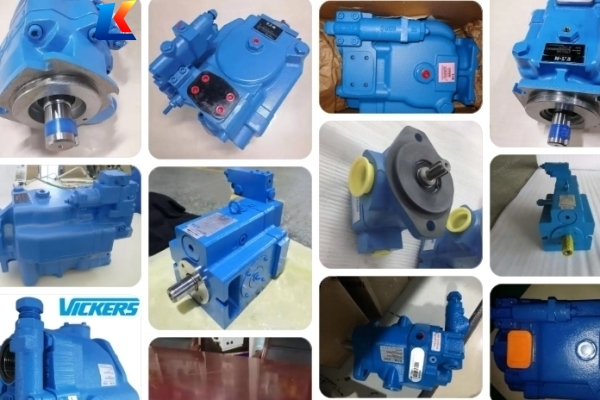
Vickers hydraulic vane pumps are widely used in industrial hydraulic systems for their high efficiency, stable performance and long service life. The normal operation of the pump relies on the close cooperation of various parts, each of which undertakes a key role. Below is a detailed introduction to the main parts of Vickers hydraulic vane pumps, including their functions and characteristics.
1. Pump Body
The pump body is the main structural component of the Vickers hydraulic vane pump, serving as the installation base for all internal parts. It is usually made of high-strength cast iron or aluminum alloy, which has good rigidity and wear resistance to withstand the high pressure generated during the operation of the pump. The inner cavity of the pump body is precisely processed to ensure the coaxiality and fit accuracy with other parts, avoiding oil leakage and improving the overall efficiency of the pump.
2. Rotor
The rotor is the core rotating part of the vane pump, which is installed on the pump shaft and rotates at high speed driven by the power source. There are evenly distributed vane slots on the circumference of the rotor, and the vanes are inserted into these slots and can move radially. The precision of the rotor directly affects the movement stability of the vanes and the volumetric efficiency of the pump. Vickers rotors are usually processed by precision grinding technology to ensure the flatness and dimensional accuracy of the vane slots.
3. Vanes
Vanesa are the key components that realize the suction and discharge of hydraulic oil. They are usually made of high-quality alloy steel or non-metallic materials (such as PTFE) with good wear resistance and elasticity. When the rotor rotates, the vanes are thrown out by centrifugal force and closely attached to the inner surface of the stator, forming a number of sealed working chambers with the rotor, stator and port plate. As the rotor rotates, the volume of the working chamber changes alternately, realizing the suction and pressure relief of hydraulic oil.
4. Stator
The stator is a fixed part installed in the pump body, with a special curved inner surface (usually an ellipse or a combination of arcs). The shape of the stator inner surface determines the movement trajectory of the vanes and the volume change law of the working chamber, which directly affects the flow rate and pressure of the pump. Vickers stators are processed by precision machining to ensure the smoothness of the inner surface, reduce the friction between the vanes and the stator, and extend the service life of the parts.
5. Port Plate
The port plate (also known as the valve plate) is installed at both ends of the rotor and stator, with suction and discharge ports opened on it. Its main function is to connect the working chambers formed by the rotor, vanes and stator with the external oil circuit, realizing the suction and discharge of hydraulic oil in an orderly manner. The port plate is closely fitted with the end face of the rotor, and a small gap is maintained to prevent oil leakage while reducing friction. Vickers port plates are usually equipped with wear-resistant layers to improve their service life under high-pressure and high-speed working conditions.
6. Pump Shaft
The pump shaft is the power transmission component of the pump, which is connected with the motor or other power sources to drive the rotor to rotate. It is usually made of high-strength alloy steel,经过 quenching and tempering treatment to improve its strength and toughness. The pump shaft is equipped with bearings at both ends to ensure smooth rotation, and the fit between the shaft and the rotor is precise to avoid relative sliding during operation, which affects the transmission efficiency.
7. Seals
Seals are important parts to prevent hydraulic oil leakage in Vickers hydraulic vane pumps, including shaft seals, static seals (such as O-rings) and dynamic seals. Shaft seals are installed at the extension end of the pump shaft to prevent oil leakage from the gap between the shaft and the pump body; static seals are used between the pump body, port plate and other fixed parts to ensure the sealing performance of the joint surface; dynamic seals are used between the moving parts (such as rotor and port plate) to reduce oil leakage while reducing friction. Vickers seals are made of high-quality sealing materials, which have good oil resistance, high temperature resistance and wear resistance.
8. Bearings
Bearings are used to support the pump shaft and ensure its smooth rotation. Vickers hydraulic vane pumps usually use deep groove ball bearings or cylindrical roller bearings, which have good load-bearing capacity and rotation accuracy. The bearings are lubricated by hydraulic oil in the pump, which can reduce friction and wear, and extend the service life of the bearings and the entire pump.
9. Springs (Optional)
Some Vickers hydraulic vane pumps are equipped with springs in the vane slots, which are used to assist the vanes to extend outward and closely attach to the inner surface of the stator when the pump starts or operates at low speed (when the centrifugal force is insufficient). This can avoid the problem of poor sealing caused by the vanes not being able to extend in place, ensuring the normal suction and discharge of the pump.